Comparative of Three Fluorocarbon Powder Coatings (ETFE, FEP, PFA): Properties and Applications
They all belong to important categories of Teflon-based coatings. Leveraging the properties of fluoropolymers, they play a protective role such as corrosion resistance, non-stick performance, and high-temperature resistance in industrial and other fields. However, the three differ in operating temperature, coating performance, and application scenarios. Specific differences are as follows:
1. ETFE Thermoplastic Fluorocarbon Powder Coating
- Core Performance: It is one of the harder types among fluoropolymer coatings, with excellent toughness and outstanding chemical resistance. It can operate continuously and stably at 149℃. This coating is only supplied in powder form and can be applied to form a coating with a maximum thickness of 1000 microns, offering strong protective durability. Its solvent-based version is further mixed with high-performance resins to enhance adhesion and wear resistance while retaining core properties like low friction and non-stickiness.
- Typical Applications: Suitable for scenarios requiring high coating hardness and wear resistance, such as industrial storage tanks and equipment casings. It can also be used on the surface of some components needing electrical insulation, compatible with various metal substrates including carbon steel and aluminum.
2. FEP Thermoplastic Fluorocarbon Powder Coating
- Core Performance: It melts and flows during baking to form a non-porous, smooth film without pinhole defects. When used with a suitable primer, it can bond firmly to metal substrates. It has excellent chemical resistance, moisture resistance, and non-stickiness, with a low friction coefficient. The maximum operating temperature is 204℃, and the processing threshold is relatively low—it can form a film by sintering at around 300℃. It is available in both powder and water-based liquid forms.
- Typical Applications: Commonly used in scenarios requiring non-stick performance and basic corrosion protection, such as small storage tanks in the chemical industry, metal mold surfaces, exhaust pipes in semiconductor manufacturing, and film lamination processes for anti-adhesion purposes.
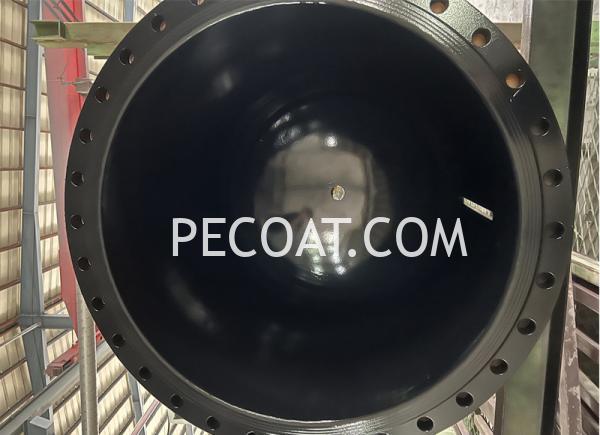
3. PFA Thermoplastic Fluorocarbon Powder Coating
- Core Performance: It also melts and levels during baking to form a non-porous film, with performance superior to FEP. The continuous operating temperature can reach 260℃, and it has stronger toughness, with a maximum film thickness of 1000 microns. It combines excellent chemical corrosion resistance, release properties, and coating uniformity. During processing, it can be applied via conventional electrostatic powder spraying or fluidized bed equipment, with strong thermal stability suitable for high-temperature coating processes.
- Typical Applications: Adaptable to scenarios with strict requirements for high-temperature resistance and chemical resistance, such as high-purity chemical transfer pipelines in the semiconductor industry, chemical reactors, and laboratory-specific equipment. It is one of the preferred coatings for industrial heavy corrosion protection and special equipment safeguarding.
To clearly show the differences between the three, the following is a comparison table of key characteristics:
| Characteristics | ETFE Powder Coating | FEP Powder Coating | PFA Powder Coating |
| Continuous Operating Temperature | 149℃ | 204℃ | 260℃ |
| Form | Powder only | Powder, water-based liquid | Powder, water-based liquid |
| Core Advantages | High hardness, strong coating durability | Low processing temperature, smooth non-porous film formation | Excellent high-temperature resistance, strong toughness, outstanding chemical resistance |
| Maximum Coating Thickness | 1000 microns | Regular thickness, no ultra-thick coating advantage | 1000 microns |