
Study on Polyethylene Powder Coatings for Battery Boxes
Abstract
Six types of polyethylene powder coatings for battery boxes were designed through the blending modification of polyethylene with different properties. By testing the melt flow rate, mechanical properties, and acid resistance of the coating films of the polyethylene powder coatings obtained from different blending schemes, the formula of polyethylene powder coating with the best comprehensive performance was screened out. The prepared polyethylene powder coating can meet the surface leveling requirements of battery boxes, and at the same time has excellent mechanical properties and chemical resistance, which can effectively improve the service life of battery boxes.
Keywords
Battery box; Polyethylene; Blending; Powder coatings
Classification Code: TQ637.82
Document Code: A
1 Introduction
With the increasingly strict requirements for environmental protection, controlling exhaust gas emissions and reducing air pollution have become important environmental protection indicators [1].
Traditional fuel vehicles generally use fossil fuels as the power source, and their most serious drawback is the emission of a large amount of exhaust gas, which severely pollutes the environment. In contrast, new energy vehicles that use storage batteries as traction power do not produce exhaust emissions and cause no pollution to the atmosphere, so they are increasingly favored by the market [2].
During the service life of industrial battery boxes, they are eroded by battery acid, which accelerates the corrosion and failure of the boxes. Therefore, the anti-corrosion of battery boxes has always been a hot research topic. Industrial battery boxes are usually made of carbon steel, which itself does not have good anti-corrosion performance [3].
Therefore, only by performing surface treatment on the inner and outer walls of the boxes can their anti-corrosion performance be effectively improved. A commonly used surface treatment technology is to apply a layer of anti-corrosion coating on the box surface, and the coating is required to not only resist acid erosion but also adhere closely to the substrate.
Polyethylene powder coatings usually consist of polyethylene resin, additives, fillers, pigments, etc. They are thermoplastic powder coatings with excellent chemical resistance and high cost-effectiveness.
Considering the anti-corrosion requirements of battery boxes, as well as the requirements for appearance and cost, polyethylene powder coatings are an economically feasible anti-corrosion coating option. However, there is a contradiction between the mechanical properties and fluidity of polyethylene. Polyethylene powder coatings are usually difficult to have both excellent fluidity and mechanical properties, so they must be modified to meet the coating requirements of battery boxes. In this study, by means of blending modification of polyethylene with different properties, a polyethylene powder coating for battery boxes was designed. This coating has excellent mechanical properties, chemical resistance, high adhesion, and good surface leveling.
2 Experimental Section
2.1 Experimental Raw Materials and Instruments
2.1.1 Raw Materials
- Polyethylene (PE-A, PE-B, PE-C): Sinopec;
- Polyethylene (PE-D): Dow Chemical;
- Polyethylene (PE-E): Prime Polymer Co., Ltd., Japan;
- Polyethylene adhesive (MAH-g-PE): Model SZ-07, Huangshan Beno Technology;
- Antioxidant: Model K7001, Luan JIENT;
- Light stabilizer: Model UV531, BASF;
- Polyethylene wax flow agent: Shanghai Additive Factory;
- Nucleating agent: Model Hyperform HPN-20E, Milliken Chemical, USA;
- Pigment carbon black: Model R600R, Cabot.
2.1.2 Instruments
- Twin-screw extruder: Model T-35, Nanjing Rub Machine , Ltd.;
- Plate vulcanizing machine: Model XLB-D, Huzhou Shyn Machinery Co., Ltd.;
- Environmental stress cracking tester: Model NYK-06, ChengdeTesting Equipment Co., Ltd.;
- Universal testing machine for plastics: Model WDS-3, Boyi InstruEquipment Co., Ltd.
2.2 Experimental Methods
2.2.1 Preparation of Powder Coatings
Raw materials were weighed according to the formula in Table 1 and added to a mixer for high-speed mixing. The mixture was then added to a twin-screw extruder for melt extrusion granulation at 160°C. The granules were put into a mill to be crushed into powder, followed by classification and sieving.
Table 1 Formula of Polyethylene Powder Coating
| Raw Materials | Weight part/ part |
| Polyethylene | 84 |
| MAH-g-PE | 15 |
| Antioxidant | 0.15 |
| Light stabilizer | 0.15 |
| Flow agent | 0.15 |
| Nucleating agent | 0.05 |
| Carbon black | 0.5 |
2.2.2 Preparation of Coatings
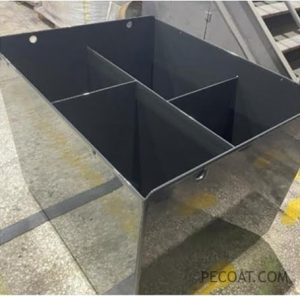
A fluidized bed dipping method was used to prepare polyethylene powder coatings on the surface of battery boxes. The surface of the battery box was first sandblasted, then heated to 250-350°C in an oven. After that, the polyethylene powder coating was applied by fluidized bed dipping, and plasticization was achieved using the residual heat of the workpiece or by placing it in an oven.
2.2.3 Preparation of Samples for Performance Testing
Samples for testing the mechanical properties of polyethylene powder were prepared by compression molding.
2.3 Performance Testing
- The melt flow rate (MFR) of polyethylene powder coatings was tested in accordance with GB/T 3682-2018;
- The environmental stress cracking (ESC) performance of polyethylene powder coatings was tested in accordance with GB/T 1842-2008;
- The tensile properties of polyethylene powder coatings were tested in accordance with GB/T 1040.2-2018;
- The acid resistance of polyethylene powder coatings was tested using a 30% (mass fraction) sulfuric acid solution in accordance with GB/T 11547-2008;
- The adhesion of polyethylene powder coatings was tested in accordance with GB/T 9286-2008.
The main performance indicators of polyethylene powder coatings for battery boxes are shown in Table 2.
Table 2 Main Performance Indicators of Polyethylene Coatings for Battery Boxes
| Performance Indicators | Test Requirements |
| MFR / [g·(10 min)⁻¹] | > 10 |
| ESC / h | > 300 |
| Tensile strength /MPa | > 10 |
| Elongation at break /% | > 500 |
| Acid resistance(30% sulfuric acid,720 h) | No severe swelling, loss of adhesion, etc. |
| Adhesion after acid immersion /grade | > 1 |
3 Results and Discussion
3.1 Performance Analysis of Polyethylene
Analyzing the performance parameters of different types of polyethylene is a prerequisite for designing the formula of mixed polyethylene powder coatings. In this study, 5 different types of polyethylene were selected as raw materials for powder coatings, and their properties were tested in accordance with relevant standards. The results are shown in Table 3.
As can be seen from Table 3, PE-A and PE-B have extremely high melt flow rates, so they can meet the requirements for high surface leveling of the coating. However, the toughness of PE-A and PE-B is relatively poor. The elongation at break of PE-A is only 100%, and its stress cracking resistance time is only 1 h, so it cannot meet the mechanical property requirements of battery box coatings. PE-C is linear low-density polyethylene with a moderate melt flow rate, which can basically meet the leveling requirements of ordinary coatings, but its toughness is also poor. Both PE-D and PE-E are metallocene linear low-density polyethylene, and both have excellent toughness and tensile strength. The difference is that PE-E has an extremely low melt flow index, which cannot meet the coating leveling appearance requirements.
Table 3 Properties of Different Types of Polyethylene
| Properties | PE-A (Low-density polyethylene) | PE-B (Medium-density polyethylene) | PE-C (Low-density polyethylene) | PE-D (Metallocene polyethylene) | PE-E (Metallocene polyethylene) |
| MFR / [g·(10 min)⁻¹] | 40 | 50 | 20 | 15 | 3.8 |
| ESC / h | 1 | 24 | 24 | 1000 | 1000 |
| Tensile strength/ MPa | 8 | 10 | 11 | 16 | 20 |
| Elongation at break / % | 100 | 300 | 200 | 1000 | 1000 |
3.2 Selection and Optimization of Polyethylene
The melt flow rate (MFR) of polyethylene is an indicator reflecting the fluidity of polyethylene in the hot-melt state, and it to a certain extent represents the leveling effect of the polyethylene coating. Generally, the higher the MFR value, the better the coating leveling effect. However, the higher the MFR value, the lower the relative molecular mass of polyethylene usually is, and the worse its mechanical properties are. Therefore, it is often difficult to meet the requirements of both fluidity and mechanical properties at the same time, which is also verified by the test results shown in Table 3. If polyethylene with different properties is mixed and used together to make the mixture have both excellent fluidity and mechanical properties, theoretically, polyethylene powder coatings with comprehensive properties meeting the requirements can be prepared.
Table 4 Different Blending Schemes
| Project | Scheme | |||||
| 1 | 2 | 3 | 4 | 5 | 6 | |
| PE-B weight part /part | 50 | 50 | 50 | 50 | 50 | 50 |
| PE-D weight part /part | 25 | 30 | 35 | 40 | 45 | 50 |
| MAH-g-PE weight part /part | 13.2 | 14.1 | 15 | 15.9 | 16.8 | 17.6 |
It can be seen from Table 3 that both PE-A and PE-B have high melt flow rates, but PE-B has relatively higher toughness, so PE-B can be used as the matrix material to improve the fluidity of the mixture; PE-D and PE-E have good mechanical properties and can be used as matrix materials to improve the mechanical properties of the mixture. However, PE-E has a low melt flow rate, so it is not suitable as a matrix material. For polyethylene with a large average relative molecular mass, such as PE-E, the chain entanglement density is high and the flow rate is low. However, when it is subjected to external loads, its yield mechanism is mainly shear deformation, and obvious molecular flow is not easy to occur, so it has high strength and toughness [6]. Therefore, PE-B and PE-D were mixed in different proportions to prepare blended modified polyethylene. At the same time, in order to improve the bonding force between the polyethylene powder coating and the battery box substrate, an appropriate amount of polyethylene adhesive (MAH-g-PE) should be added. The polyethylene adhesive is a binder prepared by grafting maleic anhydride onto polyethylene. In conclusion, 6 different blending schemes were designed, as shown in Table 4.
3.3 Performance Analysis of Polyethylene Powder Coatings
On the basis of Table 1, according to the blending schemes in Table 4, raw materials were mixed, extruded, and crushed to prepare polyethylene powder coatings. The melt flow rate, tensile properties, stress cracking resistance, and acid resistance of the powder coatings were tested in accordance with national standards. The results are shown in Table 5.
Table 5 Performance Test Results of Different Blending Schemes
| Project | Scheme 1 | Scheme 2 | Scheme 3 | Scheme 4 | Scheme 5 | Scheme 6 |
| MFR / [g·(10 min)⁻¹] | 25 | 20 | 15 | 13 | 9 | 5 |
| ESC/h | 160 | 220 | 340 | 460 | 580 | 680 |
| Tensile strength/MPa | 11 | 11.5 | 12.4 | 12.8 | 13.6 | 14.5 |
| Elongation at break/% | 360 | 500 | 580 | 620 | 660 | 760 |
| Acid resistance (30% sulfuric acid, 720 h) | No bubbles and dissolution in the coating, with serious swelling, loss of adhesion and other phenomena | No bubbles and dissolution in the coating, with dissolution, swelling, loss of adhesion and other phenomena | No bubbles and dissolution in the coating, with dissolution, swelling, loss of adhesion and other phenomena | No bubbles and dissolution in the coating, with dissolution, swelling, loss of adhesion and other phenomena | No bubbles and dissolution in the coating, with dissolution, swelling, loss of adhesion and other phenomena | No bubbles and dissolution in the coating, with dissolution, swelling, loss of adhesion and other phenomena |
| Adhesion after acid immersion/grade | 5 | 3 | 0 | 0 | 0 | 0 |
As can be seen from Table 5, the melt flow rate of the mixture decreases rapidly with the increase of the proportion of PE-D. This is mainly because when PE-B (with low relative molecular mass) is mixed with PE-D (with high relative molecular mass) and melt-extruded by an extruder, the long molecular chains wrap the short molecular chains, resulting in a rapid decrease in the melt flow rate. Therefore, the addition amount of polyethylene with low fluidity has a great influence on the fluidity of the mixture, and special consideration should be given to its addition amount when designing the formula of mixed polyethylene powder coatings. From another perspective, the fluidity of PE-D (polyethylene with low fluidity) can also be significantly improved after being mixed with PE-B (polyethylene with relatively high fluidity). This is because polyethylene with short molecular chains can be densely inserted into polyethylene with long molecular chains, causing it to form a layered structure, thereby weakening the molecular chain entanglement. Flow modifiers for high-relative molecular mass polyethylene usually use this principle to improve the fluidity of polyethylene [7].
It can also be found from Table 5 that the tensile strength and elongation at break of the mixed polyethylene powder coatings gradually increase with the increase of the addition amount of PE-D, indicating that the compatibility between the two different types of polyethylene is good. This is mainly because the enthalpy and entropy values of PE-B and PE-D are similar, so there is basically no change in the free energy of the mixture, and the compatibility between the two types of polyethylene is high. Compared with Scheme 1, Scheme 6 has a significant increase in strength, the elongation at break is increased by 2 times, and the coating toughness is significantly improved. Although the coating strength and toughness are significantly improved with the increase of the addition amount of PE-D, the improvement rate is much lower than the decrease rate of the melt flow rate. This is because the incorporation of PE-B reduces the molecular chain entanglement density of PE-D, making molecular chain flow more likely to occur during the stretching process, while the shearing effect is weakened.
For the polyethylene coating applied on the surface of the battery box, stress release caused by the tendency of the internal structure to stabilize and stress concentration formed in the corner areas may cause coating cracking. Therefore, stress cracking resistance is an important standard to measure the service life of the coating. It can be seen from the environmental stress test results in Table 5 that the stress cracking resistance of the polyethylene powder coating is consistent with its toughness, that is, the higher the coating toughness, the better the stress cracking resistance. PE-D can significantly improve the stress cracking resistance of the mixed polyethylene powder coating.
The polyethylene powder coating for battery boxes is continuously corroded by battery acid, so it must have excellent anti-corrosion performance. It can be seen from the acid resistance test results in Table 5 that after the polyethylene powder coating prepared by Scheme 1 is immersed in acid solution, there are no bubbles or dissolution, but severe swelling occurs, and the coating adhesion grade is only 5; compared with Scheme 1, the coating prepared by Scheme 2 has relatively less swelling after being corroded by acid solution, and the adhesion reaches grade 3; the polyethylene coatings prepared by other schemes have no obvious corrosion phenomenon, and the coating adhesion can reach above grade 1. Metallocene PE-D itself has excellent chemical resistance, so with the gradual increase of its addition amount, the anti-corrosion performance of the coating is gradually enhanced.
Through the performance tests of the polyethylene powder coatings with different formulas designed above, the results show that the polyethylene powder coatings prepared by Scheme 3 and Scheme 4 not only have high fluidity, but also have excellent mechanical properties and anti-corrosion performance, which can meet the performance requirements of powder coatings for battery boxes. Generally, the higher the melt flow rate of polyethylene powder coatings, the better the leveling performance and the smoother the coating surface. When the melt flow rate of commonly used polyethylene powder coatings is higher than 10 g/(10 min), it can meet the higher leveling requirements. However, the melt flow rates of Scheme 5 and Scheme 6 are lower than 10 g/(10 min), so they cannot meet the leveling requirements. Although Scheme 1 has a relatively high melt flow rate, its strength and toughness are poor, and it fails the acid resistance test; Scheme 2 has no obvious improvement in mechanical properties, and the adhesion decreases after acid immersion, so it can be applied to situations where high coating appearance requirements are required, but low mechanical properties and anti-corrosion performance requirements are required.
4 Conclusion
In this study, by mixing and using polyethylene with different properties, different blending modified polyethylene powder coating schemes were designed, and the performance of different schemes was tested. The results show that the polyethylene powder coatings designed according to Scheme 3 and Scheme 4 can not only meet the surface leveling requirements of the battery box protective coating, but also have good mechanical properties and anti-corrosion performance. The research results play an important role in the anti-corrosion protection of battery boxes, and the research ideas have important guiding significance for the modification design of polyethylene powder coatings.
References
[1] Ji Y. The domestic powder coating market grows rapidly [J]. Building Materials Industry Information, 2003(10): 17.
[2] Li Z R. Brief analysis of the predicament and countermeasures of new energy vehicle development [J]. Automobile World, 2020(4): 1.
[3] Lu J Q. Anti-corrosion technology of industrial battery boxes [J]. Shipbuilding Technology, 2001(4): 27-28.
[4] Yu G L, Wang Z H, Wang X K, et al. Latest research progress of new coatings [J]. Coating and Protection, 2019, 40(10): 49-52.
[5] Liu C Q, Cai Y M. Research on high-quality polyethylene powder coatings [J]. Coating Technology, 1993(2): 4-7.
[6] Liao H Y, Tao G L. Impact strength and melt flow rate of high-density polyethylene blends [J]. Polymer Materials Science and Engineering, 2013, 29(7): 72-75, 79.
[7] Wang S, Wang Q Z, Chen Y, et al. Research progress in fluidity modification of ultra-high molecular weight polyethylene carriers [J]. Engineering Plastics Application, 2014(10): 113-117.
Please tell me more information about this